Come play with me;
Why should you run
Through the shaking tree
As though I’d a gun
To strike you dead?
When all I would do
Is to scratch your head
And let you go.
–To a squirrel at Kyle-Na-No; William Butler Yeats
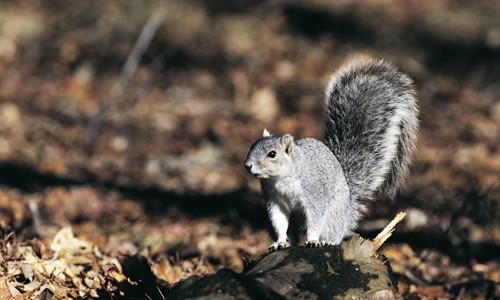
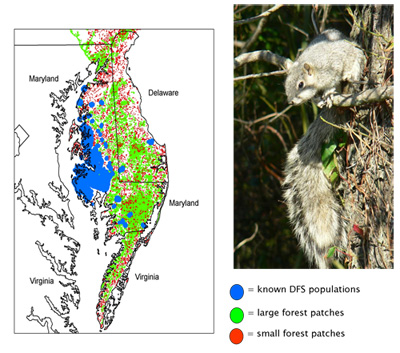
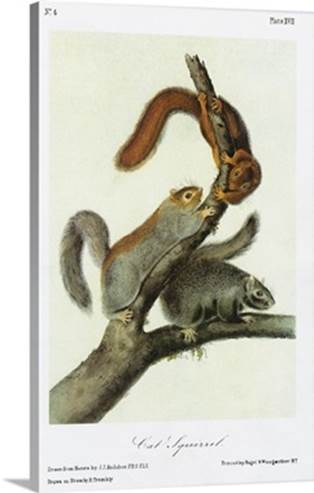
This is the largest of North American tree squirrels and can weigh up to 3 pounds, which is more than twice that of the eastern gray squirrel, a common occupant of cities and suburbs. The Delmarva fox squirrel, also called a cat squirrel, is a subspecies of the fox squirrel and is found on the Delmarva peninsula, on the east side of the Chesapeake Bay – the name is an abbreviation of the three states that make up the peninsula – Delaware, Maryland, and Virginia. In 2015 it was removed from the federal Endangered Species List since making steady recovery from when it was listed as endangered in 1967.
It has silver to whitish-gray hair and a very full and fluffy tail – the size of the body and the tail makes it easily identifiable. Most people’s comment upon seeing their first one is something like “Whoa – that is a dang big squirrel”. The total length is 30 inches with about half of that made up by its tail. Sciurus – Greek, shade-tail, and niger – black (dark phase of fox squirrel originally described) and cinereus – Latin, ash-like, for the gray of this subspecies.
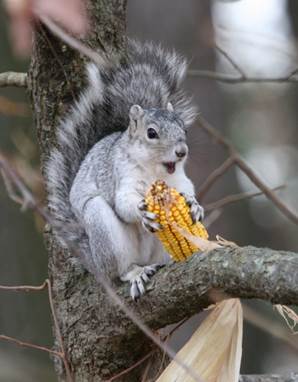
The Delmarva fox squirrel prefers mature forests of mixed hardwoods and pines with a full overhead canopy and an open understory. While it is quite adept at climbing it spends much of its time on the ground foraging for food in woodlots of mixed loblolly and hardwoods such as oak, maple, hickory, walnut, and beech trees – all of which provide seeds and nuts. They also will forage for fungi, insects, fruit and spring tree buds and flowers. It is less agile than the more common gray squirrel and will avoid confrontations by running away on the ground, climbing a tree when necessary. Fox squirrels have a home range of about 40 acres. Running around
The Delmarva fox squirrel will nest in tree cavities or build a leaf nests. They mate in late winter and early spring and the young are born 44 days later in February – March. In good habitat a female will have two litters a year and raise the young by themselves. They live up to 6 years in the wild and captive ones have lived up to 13 years.
By the early 1960’s the range of the Delmarva fox squirrel had contracted to 10% of its original distribution. Hunting of the squirrel was banned in 1971 and a long-term recovery plan was developed. The focus of the plan was to increase the population size through introduction to reestablish the squirrel throughout its historic range. Of 16 introductions in MD, DE, VA, and PA, 11 are succeeding more than a decade later. There was a long-term cooperative effort with private landowners who allowed habitat assessments and introductions of the squirrel to take place. In addition, the program has worked with farms to sustainably manage woodlots and to leave uncut corn or soybeans along forest edges. Currently about 80% of the habitat occupied by the Delmarva fox squirrel is on private land.
Chincoteague and Blackwater National Wildlife Refuges are strongholds for the species and a good place to visit if you would like to catch a glimpse of this squirrel. Way back in 1978 I was at Blackwater with a group of my fellow wildlife undergraduates and we were getting a tour by the refuge manager. It was early May but things were already warming up on the refuge – including the swarms of mosquitos and green-headed flies. Most of us were wearing long sleeves and caps and had already doused ourselves with repellent to keep off the hungry hoards, but the refuge manager was there, knee-deep in the three-square marsh giving us a lecture about the tides and vegetation associations – in a short-sleeved shirt and seemingly none the worse for wear. We thought maybe he was just immune to the biting critters after years out here in the marshlands.
We ambled down the dirt road back to the trucks and I stopped with him to check out a pair of Delmarva fox squirrels feeding on the adjacent forest floor.
“Those are some sizable squirrels, eh?” he asked.
The rest of the crew had walked ahead and then, on the DL, he asked – “Hey, do you have any of that bug juice with you? – these guys are just nasty today”.