Platypus? I thought it was pronounced platymapus. Has it always been pronounced platypus? –Jessica Simpson
One of the informal rules of OOTW is that I had to have seen the critter or plant, but we’re bending the rule a bit in honor of Steve in the Seattle office who is soon moving to Australia. And I have seen it in the zoo, which sort of counts.
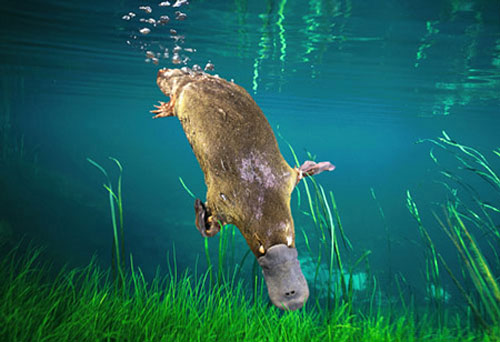
This is one very odd animal. Yes, it is a mammal – a primitive critter and one of the two members of the Order Monotremata – those mammals that lay eggs as opposed to giving live birth. The platypus is the only member of its Family and Genus. The other Montremes are the four species of spiny echidna found in Australia. Monotreme means “single hole” and refers to the common duct (cloaca) for the reproductive, urinary, and digestive systems. This is a “less evolved” system compared to modern mammals and similar to that found in reptiles. The platypus has a beaver-like tail, a duck-like bill, and webbed feet. Ornithorhynchos – Greek meaning bird snout and anatinus, the Latin for duck-like. The name platypus is a compilation of Greek meaning broad and flat foot.
The platypus is an endemic of (only found in) western Australia where it lives in rivers, streams, and other bodies of freshwater. It is a relatively common species within its range though some local populations have declined recently. Major threats are habitat modification, changes to water regime, and from tropical storms. There are some concerns about the effect of climate change and associated sea level rise and modified hydrology and its effect on the platypus. Here is one tooling along from one stream to another: http://vimeo.com/106131061
These animals weigh from 1.5 to 5.3 lbs, with males being larger than females. Males average about 20 in long, females about 13 in. So all in all, about the size of small cat. Another intriguing feature is that the platypus is one of the few poisonous mammals of the world (on my life list to see!!). They have a spur on the rear ankle that produces venom. While both male and females are born with ankle spurs, only the male’s spurs produce venom. The venom consists mostly of defensin-like proteins (DLPs) – three of which are only found in the platypus. These proteins are more commonly used as a defense against bacteria and viruses. While a dose can be lethal for small to medium-sized mammals (think a medium sized dog) it is not lethal to humans. But –a spur jab can be very painful and may cause a victim to become incapacitated temporarily.
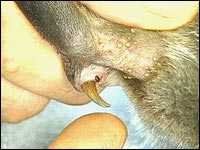
rom an 1859 issue of the Maitland Mercury: …when Mr. E. was fishing the river near his residence he found that a platypus had got entangled in the net, and upon catching the animal, it immediately struck the two spurs attached to its two floats or arms into the forefinger of Mr. E’s left hand with such force that they penetrated through the skin and into the muscles of the finger and it was with great difficulty that Mr. E at last succeeded in ridding himself of his unwelcome intruder and eventually killed it. Mr. E all the time suffered intense pain and presently the wounded finger, then the hand, and ultimately the whole arm up to the shoulder swelled to a serious extent. The symptoms usual following a snake-bite also set in, and after a day or two Mr. E’s state became so serious as to alarm his friends for his safety, and Dr. G. having been sent for, he applied ammonia and the usual remedies against snake poison and we are glad to learn that Mr. E. has now entirely recovered. Whew!!
Monotremes (platypus and echinas) also are unique among the mammals as they are the only ones to have a sense of electroreception – they locate prey by detecting the electric fields produced by the muscle contractions of their prey. How weird is that for a mammal? In the platypus the electro-recptors are located in rows beneath the skin of the bill. When the platypus dives in the water to hunt it closes its eyes, ears, and nose and digs in the bottom of streams relying on its ability to detect the electrical field of its prey, which includes worms, insect larvae, shrimp, and yappy (crawfish – Steve, hope you are picking up the local vocabulary here).
The platypus breeding season extends from June through October and males are thought to be polygynous– mating with multiple partners. Females are able to breed after their second year and can remain fertile up to 9 years. Females extend the depth of the normal burrows when pregnant and will lay one to three leathery eggs 28 days after fertilization.
Eggs only require 10 days of incubation before they hatch. The hatchlings are born blind and hairless and depend on the mother’s milk that is released through pores in the skin and then pools in grooves in the abdomen, allowing the young to lap up the milk. Monotremes have mammary glands but lack teats present in other mammals.
It is a rather inefficient but functional system. The female periodically plugs the burrow entrance, likely to prevent predation, and the males have no role in rearing the young. The female will make forays away from the den after four weeks and the young will emerge from the burrow after about four months. Platypuses are born with teeth, but lose these at an early age and make use of the horny mouth plates for grinding food. They will live about 10 years in the wild.
The platypus was not discovered until 1796 – which, in comparison, was 200 years later than the first wallaby had been seen by Europeans. In 1799 the first dried skin of a platypus made its way to London and to Dr. Shaw, the assistant-keeper in the natural history section of the British Museum. All kinds of odd fake skins were making their way to London from the far-east and one can’t blame Dr. Shaw for dismissing the skin as an obvious fake and thinking it was a duck bill grafted on a mammal body.
W.H. Caldwell travelled from England to Australia in 1884 with the explicit purpose to study the platypus. He captured and dissected a female that had laid one egg and was ready to lay another. Thrilled by his discovery he electrified the meeting of the British Association for the Advancement of Science meeting in Montreal with his terse but poignant telegram: Monotremes oviparous (egg-layers), ovum meroblasic (egg that partially divides). The assembled scientists stood and cheered upon the reading of the telegram. The platypus also is inscribed on the back of the Australian 20 cent coin.
Steve – best of luck down-under. And while fishing, remember: DO NOT PICK UP THE PLATYPUS! But please scope out the locations so I can find them easily. Cheers mate.