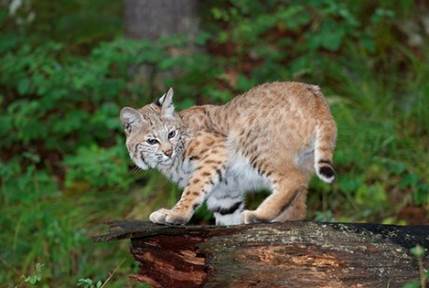
This is North America’s smallest wild cat and most widely distributed. It can be found throughout the U.S. and ranges into British Columbia and south into Mexico –excluding portions of the Midwest and high Sierra. The common name, bobcat, comes from the short, bobbed tail, which is four to six inches long. They generally weigh 15-18 pounds with larger ones tipping the scales at 24 pounds. The record is just short of 50 pounds for an adult male.
The genus name Lynx comes from the Greek for light or brightness, referencing the luminescence of its reflective eyes. The species namerufus refers to their brown color. It has black ear tufts and stripes on its short tail and distinctive black bars on its forelegs. From behind it has stripes on its ears. Its spotted coloration aids in camouflage. Bobcats are opportunistic carnivores that prey upon a variety of other animals including birds, reptiles, mice, voles, gophers, squirrels, and rabbits. In other words – they will scarf down just about anything moving that they can subdue.
Some studies indicate that rabbits consist of half of the diet of bobcats. They have been documented to hunt fawns and will take advantage of a deer killed by mountain lions, but this can be a hazardous undertaking. When bobcats take fawns or small deer they will eat their fill and then bury the carcass for later use. When hunting deer, bobcats generally will attack while the deer is bedded down, making it an easier prey objective. They will take chickens and sheep and goats occasionally. Well, ok, more than occasionally.
The National Agricultural Statistics Service indicates that bobcats killed 11,100 sheep in 2004 – though bobcats may have been blamed for other animal predators while scavenging on livestock remains. They have sharp hearing and vision and a decent sense of smell. Bobcats are excellent climbers and will swim if necessary, but tend to avoid doing so. They will live 6-8 years in the wild and rarely reach an age of 10. In captivity they have lived up to 32 years.
They are crepuscular – most active around dawn and dusk, and especially when they inhabit areas near humans, but they are adept at taking advantage of habitat corridors within the suburban and urban landscape. They are solitary as are most wildcats, with female home ranges averaging about 1.5 square miles and males with a home range double the size of a female’s. Both sexes will mark territories with scrapes (scratch out an area then pee in it), scent (rub scent glands on trees/rocks), and scat (defecate). They will also use trees as scratching posts to mark territory. Marking of territories picks up during the breeding season. Males become sexually mature at 2 years old and females can breed during their first year (9-12 months old) though this is not frequent. Most mating takes place during February or March. The gestation period is 60 days after which the female will give birth to a litter of 2-4 kittens.
The female raises the young alone and will stay with the kits in a den for a few months, straying from the den infrequently. Den sites can be thick piles of vegetation, under root-wads, small caves, hollow logs, or other secluded areas. Cougars and coyotes have been documented to kill adult and young bobcats and infrequently golden eagles will take bobcats. Bobcats are featured in Native American mythology, often tied with the coyote. Lynx (and bobcat) representing the fog, coyote the wind, as two elements of duality.
In a Shawnee tale, the bobcat is bested by the rabbit – after trapping a rabbit in a tree, the rabbit convinces the bobcat to build a fire, with the hot embers singeing his fur and leaving him with spots on his coat. Our North American bobcat is thought to have evolved from the Eurasian lynx, which sometime during the Pleistocene, trotted across the Bering Land Bridge but was soon cut off from the north by expanding glaciers.
This population then evolved into bobcats about 20,000 years ago. It is theorized that a second population arrived from Asia later and settled into the north, developing into the Canada lynx. I’ve been lucky enough to see bobcats a handful of times, quickly crossing a road or open field. But one time it was up close. I had been working in the Sandy River basin in Oregon, conducting field surveys to inform the environmental screening of two dam removals.
I was working with a PhD botanist, serving mostly as project area guide and assistant rare-plan-finder. We sat near our vehicle for lunch, a small, dead-end clearing in the forest. Scott, my partner, was sitting near the back of the truck, with me next to the rear wheel. He stopped talking and said calmly – “hey Jim, there’s an animal here and I don’t know what it is”.
Pfffft – I thought; botanists. It’s probably a mole or something. I peeked around the end of the truck and there, frozen in mid-stride as it came into the clearing 20 feet away, was an adult bobcat. With a rabbit in its mouth! I whispered – “bobcat” to Scott, as I slooooowly tried to pull my camera out of my pack with one hand while watching the cat.
But he crouched slowly, widening his paws on the ground, and poof! Was off into the forest with a leap. Enter technology. If trying to get a handle on wide-ranging and stealthy mammals, then the use of remote cameras comes as a good research tool.
Here are a couple of short videos taken in a 250 foot wide riparian corridor in Woodinville – a Seattle suburb – just last month. The corridor is between a horse barn and a number of large, suburban residential lots.
Adult: http://vimeo.com/108543220 One of the kits: http://vimeo.com/108543323 Consider yourself darn lucky if you have managed to see one – but keep an eye on the ground for prints, scrapes, scat – you never know.